
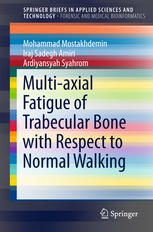

The Microstructural Failure: Multi-axial Fatigue of Trabecular Bone with Respect to Normal Walking
A stress fracture in a marathon runner or an osteoporotic vertebral crush fracture in the elderly rarely occurs due to a single, massive trauma. They occur due to fatigue failure—the microscopic, relentless accumulation of microdamage within the porous trabecular (cancellous) bone under cyclical loading. Multi-axial Fatigue of Trabecular Bone with Respect to Normal Walking is a fiercely technical, groundbreaking scientific and biomechanical manual detailing this exact failure mechanism. This volume provides the exact blueprints required to understand how bone degrades at the microscopic level.
Mastering Cyclic Loading and Microdamage
The core philosophy of this text is the engineering principle of fatigue life. The authors aggressively detail the complex, multi-axial stress states that trabecular bone experiences during a normal gait cycle. It dictates exactly how these repetitive, sub-maximal loads create microscopic cracks (microcracks) within the bone trabeculae. When the rate of microcrack formation exceeds the body’s ability to remodel and repair them (via osteoclasts and osteoblasts), macroscopic fatigue failure—a stress fracture—is inevitable.
Navigating Biomechanical Modeling
The book provides a masterclass in advanced material science. It dictates the exact computational and experimental pathways for predicting trabecular bone failure. It rigorously details the use of high-resolution micro-CT (μCT) and finite element modeling to analyze how changes in the microscopic architecture (e.g., loss of horizontal trabecular struts in osteoporosis) exponentially decrease the fatigue life of the entire bone.
Frequently Asked Questions (FAQs)
Is this a clinical manual for treating stress fractures?
No, it is a highly advanced *biomechanical engineering* text. It provides the deep, underlying science that *explains* why the stress fracture happens.
Who is the primary audience?
It is the absolute, mandatory reference for Biomechanical Engineers, Orthopedic Researchers, Bone Biologists, and advanced Sports Medicine Physicians.


