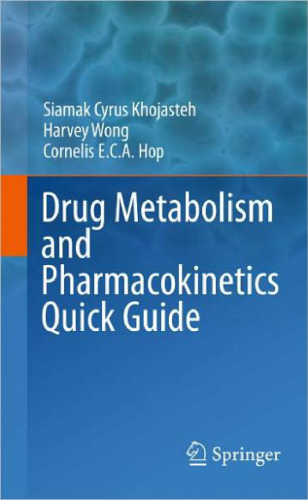
The Essential ADME Pocket Reference: Drug Metabolism and Pharmacokinetics Quick Guide
In the high-stakes environment of drug development and clinical dosing, researchers do not always have time to consult a massive, 2,000-page textbook to find a single equation. They need immediate, hyper-accurate mathematical data. Drug Metabolism and Pharmacokinetics Quick Guide is the definitive, fiercely optimized pocket reference designed for absolute speed and precision. For pharmacometricians, clinical pharmacists, and pharmaceutical researchers, this volume strips away the lengthy theoretical text and provides the pure, uncompromising equations required to instantly calculate exactly how a drug moves through the human body.
Instant Access to Critical Pharmacokinetic Data
The core genius of this guide is its ruthless efficiency. The authors have distilled the entire, massive field of ADME (Absorption, Distribution, Metabolism, and Excretion) into a highly structured, rapid-access format. The book operates like a mathematical cheat sheet for human biology. Whether the researcher needs the exact formula to calculate the Area Under the Curve (AUC) or the precise equation for determining a drug’s absolute bioavailability, the data is instantly accessible and formatted for immediate clinical application.
Demystifying Cytochrome P450 (CYP) Enzymes
This is a fiercely practical guide to the liver. The book tackles the most dangerous and complex aspect of drug metabolism: the Cytochrome P450 (CYP) enzyme system. The authors provide exhaustive, highly organized tables detailing every major CYP isoenzyme (like CYP3A4 and CYP2D6). Crucially, the guide provides rapid-fire lists of exactly which drugs induce (speed up) these enzymes and which drugs inhibit (block) them, allowing clinicians to instantly predict and prevent catastrophic, fatal drug-drug interactions.
Calculating Clearance and Half-Life Under Pressure
The book provides a masterclass in the kinetics of survival. The authors detail the absolute math required to determine a drug’s Half-Life (t1/2) and Total Body Clearance (Cl). Readers will learn the exact difference between first-order kinetics (where the body clears a percentage of the drug) and the terrifying reality of zero-order kinetics (where the body’s enzymes become overwhelmed, and the drug rapidly accumulates to lethal toxic levels, as seen in massive Phenytoin or Aspirin overdoses).
Renal Excretion and Glomerular Filtration Rates (GFR)
The guide pushes deeply into kidney function. The authors explain that standard dosing rules are useless if the patient’s kidneys are failing. The text provides the exact mathematical formulas (like the Cockcroft-Gault equation) required to rapidly estimate the patient’s Creatinine Clearance (CrCl). It then provides the precise adjustment algorithms required to lower the drug dose, ensuring the medication does not accumulate and destroy the failing organs.
Visualizing Complex Compartmental Models
The final sections address the visual representation of drug data. The authors provide clear, concise diagrams of one-compartment and two-compartment pharmacokinetic models. They teach the reader how to look at a complex logarithmic graph of a drug’s blood concentration over time and instantly extract the critical mathematical data required to adjust the patient’s next dose.
Frequently Asked Questions (FAQs)
Is this a textbook for beginners?
No. It assumes the reader already understands the basic concepts of pharmacology. It is a rapid-recall reference tool designed for professionals who need the exact equations and enzyme tables immediately.
Does it cover biologics and monoclonal antibodies?
While primarily focused on small-molecule kinetics, it touches on the fundamental differences in calculating the massive volume of distribution associated with large protein therapeutics.
Who is the primary audience?
It is the mandatory pocket survival guide for PharmD students on clinical rotations, clinical trial statisticians, and Ph.D. toxicologists.
Conclusion
Drug Metabolism and Pharmacokinetics Quick Guide proves that brilliant pharmacology relies on brilliant mathematics. It is an indispensable tool for the active clinical environment. By providing instant access to the complex ADME equations, the massive CYP interaction tables, and the critical renal adjustment formulas detailed in this volume, professionals can completely eliminate the guesswork, ensuring absolutely precise, mathematically perfect drug dosing for every patient.