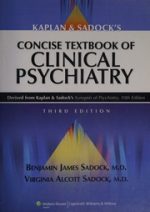


The Clinical Standard: Kaplan and Sadock’s Concise Textbook of Clinical Psychiatry, 3rd Edition
While the DSM-5 tells a doctor what a psychiatric disease is, it provides absolutely zero guidance on what to actually do about it. Kaplan and Sadock’s Concise Textbook of Clinical Psychiatry is the definitive, historically monumental, and globally recognized academic standard for the treatment of mental illness. For psychiatric residents and attending physicians, this massive volume provides the exhaustive, uncompromising blueprints required to manage everything from mild anxiety to catastrophic, violent psychosis.
Streamlined Clinical Mastery from the Comprehensive Textbook
The core philosophy of this text is exhaustive, yet accessible, clinical knowledge. The authors have taken their legendary 4,000-page “Comprehensive Textbook” and aggressively streamlined it into a single, high-yield clinical companion. It assumes the reader already knows the DSM-5 criteria, and instead focuses entirely on the complex epidemiology, the underlying neurobiology, and the absolute best-practice treatment algorithms for every disorder.
Integrating Neuroscience, Genetics, and Psychopharmacology
The book provides a masterclass in modern psychiatric science. The authors aggressively destroy the old idea that mental illness is purely “psychological.” They dedicate massive sections to neuroanatomy and neurotransmitter pathways. Readers will learn exactly how dopamine dysregulation in the mesolimbic pathway causes the terrifying hallucinations of Schizophrenia, and exactly which dopamine-blocking drugs are required to stop it.
Detailed Clinical Management and Treatment Algorithms
This is a fiercely practical guide to patient survival. The authors provide the exact pharmacological protocols for treating the most dangerous patients in the hospital. They detail exactly how to rapidly tranquilize an acutely manic, combative patient in the emergency room using a combination of Haloperidol and Lorazepam, and how to safely initiate Lithium therapy without triggering catastrophic renal toxicity.
Special Sections on Child, Adolescent, and Geriatric Psychiatry
The final value of this reference is its deep dive into specialized populations. A child is not just a small adult. The book provides explicit, rigid guidelines for diagnosing and treating ADHD and Autism in children, and critically, how to differentiate standard Alzheimer’s dementia from a reversible “pseudodementia” caused by severe geriatric depression.
Frequently Asked Questions (FAQs)
Is this book just a copy of the DSM-5?
Absolutely not. While it references the DSM criteria, this book is focused entirely on the clinical management, neurobiology, and psychopharmacological treatment of the diseases, which the DSM ignores completely.
Does it cover psychotherapy (like CBT)?
Yes, while heavily focused on psychopharmacology, it features critical sections on the evidence-based application of Cognitive Behavioral Therapy, Dialectical Behavior Therapy, and classic psychoanalysis.
Who is the primary audience?
It is the absolute, mandatory academic foundation for Psychiatry Residents, Attending Psychiatrists, and Psychiatric Nurse Practitioners.
Conclusion
Kaplan and Sadock’s Concise Textbook of Clinical Psychiatry proves that treating mental illness requires a massive, integrated understanding of both neuroscience and clinical pharmacology. It is an indispensable encyclopedia for the psychiatric ward. By studying the advanced neurobiology, the rigorous pharmacological algorithms, and the specialized population guidelines detailed in this volume, clinicians can successfully bring their patients back from the brink of psychological collapse.