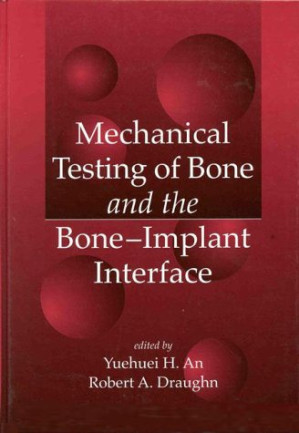


The Biomechanical Laboratory: Mechanical Testing of Bone and the Bone-Implant Interface
Before a new titanium hip stem or locking plate is ever implanted into a human patient, it must undergo absolutely grueling mechanical testing in a laboratory to prove it will not catastrophically fail under the massive, repetitive loads of human movement. Mechanical Testing of Bone and the Bone-Implant Interface is a fiercely technical, heavily mathematical engineering manual detailing exactly how these tests are designed and executed. This volume provides the exact blueprints required to subject bone and metal to ultimate failure analysis.
Mastering the Materials Testing Machine
The core philosophy of this text is controlled destruction. The authors aggressively detail the physics of servo-hydraulic testing frames (like an MTS machine). It dictates exactly how to mount a cadaveric femur and subject it to cyclic four-point bending, generating a precise stress-strain curve that reveals the exact yield point where microscopic cracks begin to propagate through the cortex.
Navigating Fixation Failure
The book provides a masterclass in evaluating surgical constructs. It dictates the exact testing pathways for comparing different surgical techniques. It rigorously details how to test the pull-out strength of a pedicle screw in osteoporotic spine models versus healthy bone models, calculating the precise Newton-meters of force required to rip the metal out of the biological matrix.
Frequently Asked Questions (FAQs)
Is this a book about how to perform surgery?
No, it is a *biomedical engineering* manual. It is about how to test the implants that surgeons use in the laboratory before they are approved for human use.
Who is the primary audience?
It is the absolute, mandatory laboratory guide for Biomechanical Engineers, Orthopedic Researchers, and Implant Design Scientists.