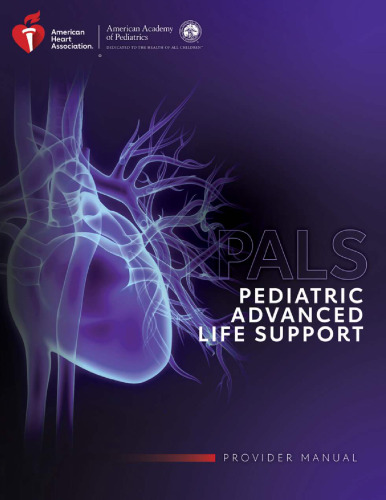


The Gold Standard: Pediatric Advanced Life Support: Provider Manual
When a child enters cardiopulmonary arrest or profound shock, there is zero margin for error. The clinical response must be instantaneous, coordinated, and flawlessly executed based on the most current scientific evidence. Pediatric Advanced Life Support: Provider Manual is the definitive, fiercely rigorous training manual mandated by the American Heart Association (AHA). This volume provides the exact, uncompromising algorithms required by healthcare providers to recognize life-threatening pediatric emergencies, initiate high-quality resuscitation, and stabilize the critically ill child.
Mastering the PALS Systematic Approach Algorithm
The core philosophy of this text is rapid, systematic evaluation. The authors aggressively drill the PALS Evaluate-Identify-Intervene sequence. They dictate exactly how to perform the initial impression (consciousness, breathing, color) and the primary assessment (ABCDE), ensuring that providers can instantly categorize the clinical problem—whether it is respiratory distress, compensated shock, or impending cardiac arrest—within seconds of encountering the patient.
Navigating Cardiopulmonary Arrest and Resuscitation
The book provides a masterclass in life-saving interventions. It dictates the exact protocols for high-quality pediatric CPR, emphasizing the critical importance of compression depth, rate, and minimizing interruptions. It provides exhaustive instructions on utilizing the cardiac arrest algorithm, dictating precise energy doses for defibrillation and the exact pharmacological sequencing for administering epinephrine or amiodarone based on the specific cardiac rhythm.
Managing Respiratory Failure and Shock
This is a fiercely practical guide to preventing cardiac arrest before it occurs. The authors provide rigid frameworks for managing the various etiologies of respiratory failure (upper airway obstruction, lower airway disease, lung tissue disease) and shock (hypovolemic, distributive, cardiogenic). The text dictates exactly when to initiate fluid resuscitation, when to utilize inotropes, and when to establish an advanced airway.
Integrating Effective Team Dynamics in High-Stress Scenarios
The final value of this reference is its focus on human performance. The text dictates the principles of effective resuscitation team dynamics. It ensures that providers understand clear role allocation, closed-loop communication, and mutual respect, transforming a chaotic emergency response into a highly synchronized, life-saving effort.
Frequently Asked Questions (FAQs)
Does this manual cover post-cardiac arrest care?
Yes, it features critical sections on targeted temperature management, optimizing ventilation and oxygenation, and ensuring adequate tissue perfusion after the return of spontaneous circulation (ROSC).
Are there specific guidelines for recognizing arrhythmias?
Absolutely. It provides explicit ECG examples and specific management algorithms for pediatric bradycardia, supraventricular tachycardia (SVT), and ventricular tachycardia.
Who is the primary audience?
It is the absolute, mandatory training manual for Pediatricians, Emergency Room Physicians, ICU Nurses, Paramedics, and any healthcare professional responding to pediatric emergencies.
Conclusion
Pediatric Advanced Life Support: Provider Manual proves that surviving a pediatric code is not about luck; it is about rigorous, standardized preparation. It is the indispensable bedrock of pediatric emergency response. By mastering the systematic approach, the resuscitation algorithms, and the team dynamics detailed in this vital volume, providers can deliver the precise interventions required to save a child’s life.