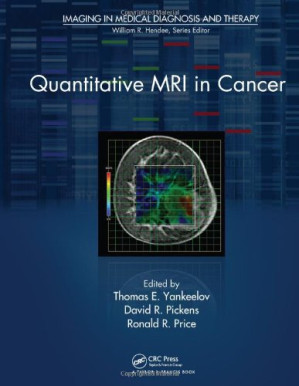

The Mathematical Image: Quantitative MRI in Cancer
A standard MRI simply shows you a black-and-white picture of a tumor’s size. That is no longer enough. The future of oncology requires us to look at an MRI and extract mathematical data proving exactly how many blood vessels are inside the tumor, and exactly how densely packed the cancer cells are. Quantitative MRI in Cancer is a fiercely advanced, highly computational radiological manual detailing the transition from taking pictures to measuring biology. This volume provides the precise physical blueprints required to turn a scanner into a non-invasive biopsy tool.
Mastering Diffusion-Weighted Imaging (DWI)
The core philosophy of this text is the physics of cellular density. The authors aggressively detail the mechanics of the Apparent Diffusion Coefficient (ADC). It dictates exactly how a radiologist programs the MRI to measure the microscopic movement of water molecules inside the tumor; if the cancer cells are explosively multiplying and packed tightly together, the water is trapped, instantly proving the tumor is highly aggressive without ever touching a scalpel.
Navigating Dynamic Contrast-Enhanced (DCE) MRI
The book provides a masterclass in vascular mapping. It dictates the exact algorithmic pathways for calculating the transfer constant (K-trans). It rigorously explores how to inject a contrast dye and mathematically track exactly how fast it leaks out of the tumor’s corrupted blood vessels, allowing the oncologist to prove whether a billion-dollar anti-angiogenic drug (like Bevacizumab) is actually choking the tumor to death within 48 hours of the first dose.
Frequently Asked Questions (FAQs)
Does this book teach you how to treat cancer with radiation therapy?
Absolutely not. It is a strictly specialized *medical physics, diagnostic radiology, and imaging biomarker textbook* focused entirely on the computational analysis of magnetic resonance signals.
Who is the primary audience?
It is the absolute, mandatory definitive reference for Diagnostic Radiologists, Medical Physicists, Bioengineers, and Translational Oncologists.