Visualizing Medical Science: Pharmacology: An Illustrated Review
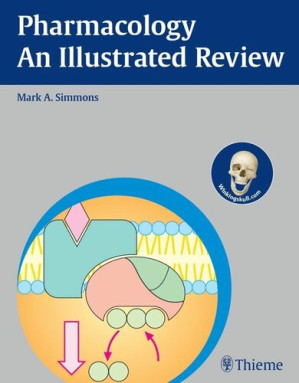
Pharmacology is universally recognized as one of the most conceptually dense and volume-heavy subjects in the entire medical curriculum. Attempting to master it by reading endless pages of black-and-white text is a recipe for fatigue and poor retention. Pharmacology: An Illustrated Review (Thieme Illustrated Reviews) completely revolutionizes the study experience. Authored by Mark A. Simmons, this brilliant textbook leverages the immense power of visual learning, transforming a daunting mountain of pharmaceutical data into highly organized, beautifully illustrated, and easily digestible concepts. It is the ultimate high-yield study companion for medical, dental, nursing, and pharmacy students preparing for high-stakes board examinations.
The Ultimate Study Tool for Visual Learners
The human brain processes images up to 60,000 times faster than text. The Thieme Illustrated Reviews series capitalizes on this neurological reality. The book features hundreds of stunning, full-color illustrations that do not merely decorate the pages; they actively teach the material. Instead of reading a three-page description of how a diuretic acts on the nephron, the student is presented with a clear, color-coded schematic that instantly maps the exact site of action, the specific ion transporters inhibited, and the resulting physiological effects on urine volume and blood pressure. This visual anchoring makes long-term recall significantly easier during stressful exams.
Translating Complex Mechanisms into Clear Diagrams
The brilliance of this book lies in its ability to simplify without “dumbing down” the science. It takes the most complex biochemical pathways—such as the intracellular signaling cascades of G-protein coupled receptors or the intricate coagulation cascade—and breaks them down into logical, step-by-step flowcharts. By visualizing the mechanism of action (MOA) in this manner, students move away from fragile rote memorization and towards a robust, intuitive understanding of why a drug works.
High-Yield Concepts and Board Review Preparation
This is not an exhaustive, 2,000-page encyclopedic reference meant to gather dust on a shelf; it is a tactical, high-yield review guide designed for active studying. The text is formatted using incredibly efficient outlines, bullet points, and summary tables. It aggressively highlights the specific, heavily tested facts required for the USMLE Step 1, COMLEX, and NAPLEX exams. The book strategically focuses on:
- Clinical Indications: What the drug is primarily used to treat.
- Mechanism of Action (MOA): Exactly how it works at the cellular level.
- Adverse Effects: The most common, the most dangerous, and the highly specific “classic” side effects favored by board examiners (e.g., dry cough with ACE inhibitors, or red-man syndrome with Vancomycin).
- Contraindications: Crucial safety information regarding when a drug must never be used.
Systems-Based Organization for Maximum Efficiency
Aligning with modern medical school curricula, the book is organized strictly by body systems (e.g., Autonomic Nervous System, Cardiovascular System, Endocrine System). Each chapter begins with a concise, beautifully illustrated review of the normal anatomy and physiology of that system. This vital context ensures that students understand the baseline function before they attempt to memorize how pharmacological agents alter or inhibit that function.
Clinical Vignettes and Practice Questions
To truly prepare for board exams, students must practice answering clinical vignettes. At the conclusion of every major section, the book provides a series of challenging, USMLE-style multiple-choice questions. Crucially, the answers are accompanied by detailed rationales explaining not only why the correct answer is right, but why the other options are specifically incorrect, serving as a powerful secondary review mechanism.
Frequently Asked Questions (FAQs)
Can I use this as my only pharmacology textbook?
For the vast majority of students focused on board preparation, the depth and clarity provided by this illustrated review are more than sufficient to serve as a primary study resource.
Does it cover antimicrobial and chemotherapeutic agents?
Yes, the chapters on antimicrobials and antineoplastic drugs are particularly strong, utilizing brilliant diagrams to illustrate exactly how different drugs target the bacterial cell wall, ribosomes, or cancer cell DNA.
Are the illustrations available digitally?
Purchasing the text typically includes a scratch-off code for complimentary access to the digital version on Thieme’s platform, allowing for easy studying on tablets and smartphones.
Conclusion
Pharmacology: An Illustrated Review is the antidote to pharmacology burnout. By perfectly synthesizing high-yield clinical text with unparalleled, full-color diagrams, Mark A. Simmons has created a study tool that is as engaging as it is effective. If you are a visual learner seeking to conquer your pharmacology coursework and crush your board exams, this book is an absolute, non-negotiable must-have.