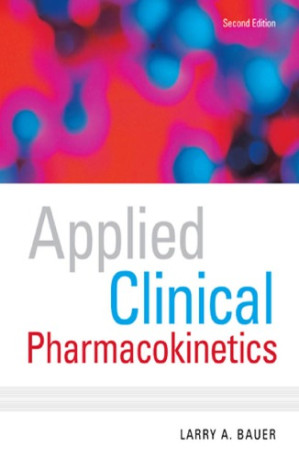
Precision Dosing: Applied Clinical Pharmacokinetics
In the high-stakes environment of a hospital ICU, guessing a drug dose is a lethal mistake. For powerful, narrow-therapeutic-index medications, a dose that is just 10% too low will fail to cure the patient’s raging infection, while a dose that is 10% too high will permanently destroy their kidneys. Applied Clinical Pharmacokinetics, Second Edition is the definitive, rapid-fire clinical manual that eliminates the guesswork. For clinical pharmacists, medical residents, and critical care physicians, this text translates complex mathematical theories into immediate, bedside-ready dosing protocols, ensuring every single patient receives the exact milligram of medication their unique body requires.
Translating Mathematical Models to the Hospital Bedside
Many pharmacokinetics textbooks are written by mathematicians for mathematicians, filled with esoteric calculus that is utterly useless to a doctor standing over a dying patient. This book is different. It strips away the unnecessary theoretical equations and focuses entirely on applied clinical math. The authors teach the reader how to use simple, reliable algebraic formulas to calculate exactly how a specific patient’s body (based on their age, weight, and lab results) is absorbing and excreting a drug right now.
Dosing Aminoglycosides and Vancomycin
The core of the manual provides a masterclass in dosing the hospital’s most dangerous antibiotics: Aminoglycosides (Gentamicin/Tobramycin) and Vancomycin. Readers will learn the precise protocols for ordering Peak and Trough blood levels. The text explains exactly how to take a trough level that came back dangerously high and mathematically adjust the dosing interval (changing a Q12H dose to a Q24H dose) to ensure the bacteria are killed while the patient’s hearing and kidney function are fiercely protected.
The Narrow Therapeutic Index of Digoxin and Phenytoin
The book provides exhaustive, step-by-step algorithms for managing chronic, highly toxic medications. It details the complex, non-linear (Michaelis-Menten) kinetics of the seizure drug Phenytoin. The authors explain why standard dose increases can instantly trigger a toxic coma, providing the exact formulas required to safely titrate the drug. Furthermore, it covers the massive dangers of dosing Digoxin for heart failure, especially in the elderly.
Adjusting Doses for Renal Failure and Hepatic Impairment
A patient’s kidneys and liver dictate how long a drug stays in their body. The text provides a rigorous guide to adjusting medication in organ failure. Readers will master the Cockcroft-Gault equation for estimating Creatinine Clearance (CrCl), learning exactly how to slash a drug’s dose when a patient goes into acute renal failure, or when they are placed on continuous renal replacement therapy (CRRT) or dialysis.
Managing Complex Drug-Drug Interactions
The final chapters deal with the reality of polypharmacy. The authors explain how adding a strong enzyme inhibitor (like Amiodarone) will instantly destroy a patient’s ability to clear other drugs, requiring the clinician to preemptively reduce the doses of all concurrent medications before a massive toxicity crisis occurs.
Frequently Asked Questions (FAQs)
Is this a reference book or a workbook?
It functions as both. It is packed with real-world clinical case studies and practice problems, forcing the reader to actually perform the math required to fix a dangerous dosing error.
Does it cover pediatric dosing?
Yes, it specifically highlights the vastly different volume of distribution (Vd) and rapid clearance rates found in neonates and children.
Who is the primary audience?
It is the absolute gold standard for Doctor of Pharmacy (PharmD) students, clinical pharmacy residents (PGY1), and any physician managing critical care patients.
Conclusion
Applied Clinical Pharmacokinetics is the ultimate weapon against adverse drug events. It proves that brilliant medical care is fundamentally rooted in precise mathematics. By strictly adhering to the rigorous dosing algorithms and safety protocols detailed in this manual, healthcare providers can confidently navigate the most dangerous medications in the hospital formulary, guaranteeing absolute maximum efficacy while fiercely protecting the patient from harm.