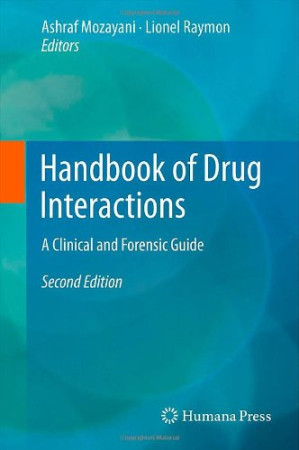

The Polypharmacy Decoder: Handbook of Drug Interactions: A Clinical and Forensic Guide
In modern medicine, patients rarely take just one pill. The average elderly patient takes five to ten different medications daily, creating a massive, terrifying chemical experiment inside their liver. Handbook of Drug Interactions: A Clinical and Forensic Guide is the definitive, fiercely advanced reference manual designed to decode this chaos. For clinical toxicologists, hospital pharmacists, and forensic pathologists, this volume provides the absolute, uncompromising scientific data required to predict fatal interactions before they happen, or explain them in a courtroom after a patient has died.
A Critical Guide for Clinicians and Forensic Pathologists
The core philosophy of this handbook is dual utility. It operates as both a preventative shield for the living and an investigative tool for the dead. The authors bridge the gap between clinical pharmacy (preventing the error on the ward) and forensic toxicology (proving the error during an autopsy), providing a unique, incredibly powerful perspective on the lethality of mixed medications.
The Molecular Mechanisms of Cytochrome P450
This is a fiercely scientific deconstruction of the liver. The book does not just list that “Drug A interacts with Drug B.” It provides the exact, molecular physics of why. The authors detail the Cytochrome P450 (CYP) enzyme system, explaining exactly how a specific antibiotic can physically bind to the liver’s CYP3A4 enzyme, shutting it down completely, and causing the patient’s cholesterol medication to skyrocket to toxic levels.
Predicting and Preventing Lethal Combinations
The core of the clinical section provides a masterclass in risk management. The authors provide massive, heavily referenced tables detailing the most dangerous known combinations. They focus heavily on narrow-therapeutic-index drugs (like Warfarin, Lithium, and Digoxin), where a seemingly minor interaction with over-the-counter ibuprofen can trigger a massive, fatal hemorrhage or complete renal failure.
Forensic Analysis of Post-Mortem Toxicology
The book pushes into the grim reality of the morgue. When a patient dies unexpectedly, the forensic pathologist must determine if it was a disease or a drug interaction. The authors provide rigorous guidelines for interpreting post-mortem blood and tissue concentrations. They teach the toxicologist how to mathematically prove that while the levels of two drugs were individually “safe,” their combined synergistic depression of the central nervous system was the actual cause of death.
Managing Interactions in Vulnerable Populations (Geriatrics)
The final value of this reference is its focus on the most at-risk patients. The authors detail the drastic changes in pharmacokinetic metabolism that occur as the human body ages. They provide strict algorithms for managing extreme polypharmacy in geriatric patients, teaching the clinician how to systematically “de-prescribe” interacting drugs to save the patient’s liver and kidneys.
Frequently Asked Questions (FAQs)
Is this a quick-reference guide for a busy doctor?
While it contains rapid-reference tables, it is primarily a deep, highly detailed scientific and forensic reference text. A quick digital database (like Lexicomp) is better for a 10-second check, while this book provides the deep “why” and the legal/forensic backing.
Does it cover interactions with herbal supplements?
Yes, it features critical sections on the often-ignored dangers of herbal supplements (like St. John’s Wort), which can massively alter liver enzymes and destroy the efficacy of prescription drugs.
Who is the primary audience?
It is the absolute, mandatory reference for board-certified clinical pharmacists, medical toxicologists, forensic pathologists, and medical examiners.
Conclusion
Handbook of Drug Interactions proves that combining chemicals is an act of profound danger. It is an indispensable guide for both the hospital and the laboratory. By mastering the CYP enzyme mechanics, the forensic interpretation of drug levels, and the rigid polypharmacy protocols detailed in this volume, professionals can either prevent a fatal overdose or scientifically prove exactly why it happened.