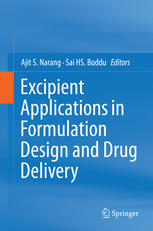
The Hidden Science of the Pill: Excipient Applications in Formulation Design and Drug Delivery
When a patient swallows a 500mg pill, only 10mg of that pill is the actual active drug. The other 490mg consists of a highly engineered, fiercely complex mixture of chemicals designed to ensure that the 10mg of drug survives the stomach, dissolves in the intestines, and enters the blood at the exact correct speed. Excipient Applications in Formulation Design and Drug Delivery is the definitive, uncompromising industrial manual dedicated to these “inactive” ingredients. For formulation scientists, industrial pharmacists, and chemical engineers, this volume provides the absolute blueprints for physically building a functioning medication.
Why the Inactive Ingredients Matter More Than the Drug
The opening chapters of this book destroy the illusion that the active drug (API) is all that matters. The authors establish that a brilliant API is completely useless if it turns into a rock in the stomach or degrades into a toxic poison on the pharmacy shelf. The text rigorously details the science of excipients—the binders, disintegrants, lubricants, and polymers—that physically construct the delivery vehicle.
The Physics of Tablet Binding and Disintegration
The core of the textbook provides a masterclass in industrial physics. The authors exhaustively detail the mechanics of the tablet press. Readers will learn exactly how to select the perfect “binder” (like microcrystalline cellulose) to ensure a tablet can withstand 10,000 pounds of pressure without shattering, while simultaneously selecting the perfect “disintegrant” to ensure the tablet violently explodes into a powder the second it hits the water in the stomach.
Designing Extended-Release (ER) Polymer Matrices
This is a fiercely detailed guide to advanced pharmacokinetics. The book tackles the massive engineering challenge of Extended-Release (ER) pills. The authors teach scientists exactly how to weave the active drug into a complex microscopic web of hydrophilic polymers. They provide the exact mathematical formulas required to calculate how fast the polymer will swell in the stomach, releasing the drug at a perfect, continuous rate over 24 hours.
Overcoming Extreme Drug Insolubility
The book pushes into the most common nightmare in modern drug development: the drug looks like a brick and refuses to dissolve in water. The authors provide the exact chemical engineering strategies required to fix this. They detail the use of complex excipients like cyclodextrins (which act as molecular cages to hide the hydrophobic drug) or lipid-based nanoparticles, forcing the human body to absorb a drug it naturally wants to reject.
The Regulatory Nightmare of Excipient Toxicity
The final chapters address the reality of FDA regulation. The authors provide exhaustive guidance on excipient safety. Just because an ingredient is “inactive” does not mean it is safe. The text details the rigorous toxicological testing required to prove to the government that the polymer matrix you designed will not accidentally poison the patient’s liver after ten years of daily use.
Frequently Asked Questions (FAQs)
Does this book teach me how the drug works in the body?
No. This is a formulation engineering textbook. It teaches you how to physically build the pill, not how the drug interacts with cellular receptors.
Is a background in physical chemistry required?
Absolutely. This is a highly advanced professional text requiring a profound understanding of thermodynamics, fluid mechanics, polymer chemistry, and industrial engineering.
Who is the primary audience?
It is the absolute gold-standard reference for Ph.D. Formulation Scientists, Industrial Pharmacists, and Chemical Engineers in the pharmaceutical manufacturing sector.
Conclusion
Excipient Applications in Formulation Design proves that building a pill is a masterpiece of physical chemistry and engineering. It is an indispensable guide to the absolute reality of drug manufacturing. By mastering the physics of tableting, the complex polymer matrix designs, and the solubility enhancement strategies detailed in this volume, scientists can successfully transform a raw, useless powder into a highly advanced, life-saving medical delivery system.